Wednesday, October 24, 2012

A Photographic Study in "Terranga" [sic]

The Wolof word for hospitality is teranga and it is given such importance in Senegalese culture that it is widely considered to be part of the national identity.  In fact, the national soccer team is nicknamed the Lions of Teranga.  Occasionally I have seen it misspelled "terranga", and it is interesting that the misspelling occurs on terra-, which of course in Latin means Earth.

Interestingly there is a strong connection between the Earth and the fortunes and well-being of the people that inhabit it.  A nation and its people are ultimately defined by the land - its bounty (eg. diamonds, oil, etc.) often times, as we've see in other parts of Africa and around the world, leads to corruption and strains on society through domestic violence, alcohol abuse and other violent crimes.  Here in Senegal, the land in places is harsh but it does provide enough for its people.  It seems the Senegalese recognize this, and despite the far-reaching poverty, I have not seen happier, more welcoming people willing to share with family, friends and strangers equally.  They are not driven by greed and there is deep respect for the land and for all people.

What follows is a photographic study of this fascinating notion of "terranga": the land, the people, and how that all comes together to define way of life here in Senegal.  Without a doubt, teranga is what has so far made our experience with IBM Corporate Service Corps so wonderful. #ibmcsc

The Land

A majestic coastline makes Senegal a welcoming gateway for Western Africa to the rest of the world

The bounty of the ocean feeds the people of Senegal

The soil of this land is sandy but fertile

The sun shines bright to give life, but can be too intense for life as well 


The People

The women work hard and are strong, making Senegal a matriarchal society
The children are playful
The family unit is strong
And the people are proud


The Way of Life


Beautiful tree-lined city streets are currently blighted by nature - left dusty by the sediment from the recent floods

96% of the population is Muslim (this week preparing for Eid al-Adha) and live in perfect harmony with Christians 

It is a vibrant society with streets always bustling with people of all ages

But still struggling to catch up with the Western World


The postings on this site are my own and don't necessarily represent IBM's positions, strategies or opinions.

Monday, October 22, 2012

A Land of Opportunity

As our plane approached Dakar late Friday night, coming in from over the Atlantic Ocean the city lights presented a spectacular perspective of the city, but little evidence of a country on the brink of dramatic change.  Dakar, also know as Presqu'ile, or "almost island" since it is nearly completely surrounded by the ocean, by night seemed highly concentrated within a very small area along the coastline.
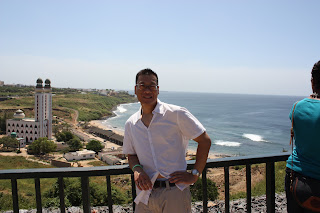
Beautiful Dakar, Senegal
But as we explored the city the next day, what we saw was a city growing rapidly, with partially constructed buildings sprouting up everywhere we looked, and even as we left Dakar, deep into the suburbs the endless residential construction did not seem to end.  In fact, the decrepit single-runway airport we had just landed at is about to be replaced by a brand new one further inland, to be connected to the city by a brand new tollway going up right now (along the route to our final destination in Thiès, #Senegal.)   The land on which the airport currently sits is just too valuable as oceanfront property to house an airport.

I'd say my first impressions of this country and the wonderfully friendly people of this nation are quite different than what I was expecting. I have been entirely comfortable, with no real loss in amenities.  I have taken hot showers, found most places we've visited, including our hotel rooms, effectively air conditioned, and I have had no problems recharging my iPhone!  I've even been provided with a local cell phone that may seem dated (no touchscreen) by our Western standards.  But if anything, it shows that the digital divide in Africa is rapidly closing, and that technology - mobile in particular - seems to truly be the great equalizer.

Samsung still rules here.
And the countryside we travelled through was anything but deserted or barren. In fact, it was absolutely lush and green, as Senegal is just coming out of the rainy season.  The roadways are bustling with locals selling their fruits and vegetables. And baobab trees, made famous by the children's novella "The Little Prince", dot the landscape for as far as the eyes can see.

Road to Thiès

As foreigners we have stood out like a sore thumb and are constantly being hounded by the hawkers and beggars, but I have actually enjoyed the interactions with many of them. Despite their limited education, they have mastered basic phrases in many languages, and most are extremely adept at French, and some cases, even English.  However, it is truly heartwrenching to see the young children and the handicapped, and I am looking forward to contributing to the future prosperity of the nation in a far more enduring way, as part of IBM Corporate Service Corps #ibmcsc.

Of course we have been advised by our IBM handlers to ignore or politely brush the hawkers and street kids aside, but sometimes it is hard to be rude to such friendly, entertaining and interesting people.  I have made a few new "friends" on the streets of Dakar, like a young man named Ali who sold me 2 Senegalese wood carvings he apparently made himself with his own bare hands - which he was selling alongside a fellow who was first his brother, then his friend, and then back to being his blood brother.  It was a playful banter, where he personalized the conversation masterfully.  Each art piece started out at $25, but since I was his friend and as a #Canadian, a friend to his entire nation (alluding to the visit last week by Prime Minister Stephen Harper), I could have one for $10.  And as he followed me from our bus to the restaurant, I assured him that I would think about it, as I had no money on me.  Not surprisingly, he was right there waiting for me when our lunch was over, and as my Indian colleagues were able to expertedly negotiate with his "brother" down to 2 for $10 or 2 for $12, he begrudingly matched the lower price I claimed would now be the only acceptable deal.  For the spirited conversation, I threw in an extra $1 so he could "get something to eat".

And there was one more delightfully unforgettable conversation I had along the street there.  It was with an older gentlemen who was trying to sell me some jewelry.  His line: "My friend, how many wives do you have?"  He was visibly disappointed in me when I said one, after which he espoused about the virtues of multiple wives and the great happiness of all three of his.  He encouraged me for a good block to find a few more wives, without even trying to sell me any of his wares.

I believe it is this great spirit embodied in all the people we have met so far that will lead Senegal forward.  Their openness has resulted in stability.  Prosperity shall come next.


The postings on this site are my own and don't necessarily represent IBM's positions, strategies or opinions.

Tuesday, October 16, 2012

Bon Voyage

As the clock ticks down to the heart-wrenching goodbyes to my wife and kids, the pre-travel jitters and intrepidation of flying to Dakar, #Senegal via Paris, France in Economy... on Air France (although that seems entirely appropriate since the nature of my work is purely philanthropic #ibmcsc) slowly turn to feelings of excitement and anticipation.


I've packed one suitcase to check-in, carefully managing the weight to remain below 50 lbs., which was quite the challenge since as one of three US-based team members, I'm carrying along a slew of IBM memorabilia for our global team to share with our gracious hosts.  My carry-on contains a couple changes of clothes, all my toiletries and my Canon digital SLR camera and lenses, while my personal item will house my laptop and a few good reads.  Now besides having to pack for four weeks versus four days, were there things I packed that I normally wouldn't on a typical business trip? 
  • My own bath towels, as we were advised the ones provided by the hotels in Africa will be rather thin compared to what we're used to at the Westin and the like!
  • Likewise we were told not to expect the same soothing and sweet-smelling spa-quality soaps, shampoos and lotions we are so accustomed to from the high end hotel chains, so I have packed a few of the ones I took during my last stay at the Westin ;)
  • A generous supply of Cipro, and an entire box of Immodium...
  • Malaria medicine (Malarone) that I'll need to take daily, and of course half a dozen or so cans of mosquito repellent.  Now I suppose the latter isn't altogether unique as I'd need the same if I were traveling back to Winnipeg, Canada for the summer - just minus the risk of Malaria.
  • Hand sanitizer with 65% alcohol content, exceeding the recommended minimum of 50%!
  • And this one was actually a regular item for family vacations only a few years back, but certainly not something I have ever packed on a business trip - a pack of baby wipes.  We have a lot left over, and I'm sure they'll come in handy in Senegal where the sanitary conditions will not be up to Western standards.
These past few days have been a whirlwind.  My hair is cut, the lawn is mowed, and the Halloween decorations are up on the house.  Today I'll do something special for my daughter and get into her kindergarten classroom for a little bit of volunteering.  Tomorrow night, thanks to the NHL lockout* and the generosity of the San Jose Sharks organization, season ticket holders will descend upon HP Pavilion and skate on the very ice the professionals do!  That'll give me some great father-son time before I head off for four weeks. 

(*The bright side to the NHL lockout is that I won't miss any games while in Senegal, nor need to stay up till 4 am to stream games with NHL Gamecenter Live!)

[Updated 10/17/12]
Skate Night at HP Pavilion, San Jose, CA

My four week tour of duty in Senegal will surely be a once in lifetime experience, but it won't be without its sacrifices. I'll miss my son's annual kung fu performance next weekend, where he'll be displaying the wu shu skills he's accumulated since he was 3.5 years old.  Now 7, he has achieved the rank of blue belt and continues to impress.  His Mite (U8) travel hockey season is in full swing, and I'm disappointed that I'll have to miss his thrice-weekly practices and upcoming exhibition games and tournaments in Vacaville and Oakland.  I'll also be missing a handful of games myself for the two teams I skate for in the Sharks Ice Adult Hockey League. Inevitably when I return, I will have relinquished the scoring lead in the EEEE Division (8 points after 3 games). While the point total is correct, a few of the goals should have been assists, and the running joke with my teammates is how many goals I'll be credited with while overseas!

And through all this, it'll take a very special woman to make sure everything continues to run smoothly for the next 4 weeks - my wife and Super Mom.


The postings on this site are my own and don't necessarily represent IBM's positions, strategies or opinions.

Thursday, October 4, 2012

Visions of sugar plums (organic mangos) dancing in my head...

My taste buds are salivating and my mind is spinning.  Moments ago I got off our #IBMCSC #Senegal sub-team's kickoff call with M. Souleymane Bassoum, Chef d'Enterprise at Agrécol Afrique (AA). 

Trained as an agricultural engineer in France and Sweden, for the past 20 years Souleymane has worked hard to develop the organic food market in Senegal, helping to establish a weekly market in Thiès and two organic restaurants that draw people from as far away as Dakar (over 1 hour drive).  The Senegalese are well-known for their Teranga (which means hospitality in Wolof) and Souleymane has already invited us to dine at his restaurants!  My legendary appetite awaits...  as I eagerly anticipate conducting additional 'primary market research' in the outdoor markets and on the farms!


What happens today is AA works with roughly 150 farmers who year-round raise poultry, grow fruits (papayas, mangos, etc.) and vegetables (tomatoes, onions, etc.), or that grow rainy season products (millet) that are only available from July to October.  These farmers have entered into a contractual relationship with AA, who provides organic methods and materials (e.g. seeds, fertilizer), picks up and distributes products, in exchange for profit-sharing.

Our challenge will be to help Souleymane and AA grow the percentage of farmers who are organic from somewhere between 2 and 7% to 25%, in order to meet the burgeoning demand for organic products throughout Senegal, where consumers are willing to pay a 10% premium on most products, and in some cases, up to 25% for organic mangos!  (The mango is hands down the undisputed king of fruits across the globe and I'm looking forward to tasting some of those delicious organic Senegalese mangos, which currently are not exported.  Now I'll probably be enjoying them in some French-inspired desserts, as the mango season ended in September, and my sweet tooth has absolutely no problems with that.)

The logistics of getting products to market and collecting payments appear be their biggest challenges, and the IBM team of Rajesh Agarwal (India), Nami Matsumoto (Japan) and myself are ready to consult and recommend solutions and approaches that will help AA expand their operations. We land in 2 weeks.


The postings on this site are my own and don't necessarily represent IBM's positions, strategies or opinions.

Wednesday, September 19, 2012

You had me at "Organic Food"


Anyone who knows me, knows I love food (in mind-blowingly large portions). 


What the pho?  That's me in a pho-eating challenge (traditional Vietnamese beef noodle soup dish)

Make it organic, and even better! Combine that with transformative supply chain management and some visionary strategic market planning, and you'd have nothing short of a perfect match for my in-country IBM CSC assignment. #ibmcsc #senegal

Moments ago, CDC Development Solutions distributed our in-country assignments and I couldn't be more excited to be assigned to a project with Agrécol Afrique.

Agrécol Afrique website (en français)
Agrécol Afrique works to strengthen the vision, practice and promotion of organic farming in Senegal and throughout West Africa. Their objectives are:

  • To contribute to the development of organic agriculture through the promotion of fair trade
  • To contribute to the fight against poverty by helping to significantly increase in the incomes of the target groups of the project.
Paraphrasing the Scope of Work, our primary objective will be to develop a strategic plan for the expansion of Agrécol Afrique's operations on a national scale.  This will include providing key recommendations on scaling the business via online/mobile solutions. 

My mind is already spinning with all the opportunities to combat poverty via sustainable agriculture, and the underlying need for supply chain plannning and execution solutions, and e-commerce capabilities to expand reach on a national scale.  Hello #smartercommerce


The postings on this site are my own and don't necessarily represent IBM's positions, strategies or opinions.

Tuesday, September 18, 2012

I may not be Angelina Jolie...

My Twitter feed @ThomasDongIBM has chronicled the twists and turns along the way, but at last I am exactly one month from touchdown in Senegal, where I will be headed as part of IBM Corporate Service Corps (CSC) on the inaugural philanthropic team from IBM. #ibmcsc #senegal 

As the name of the program suggests, IBM has modeled a corporate citizenship and leadership development program based on the Peace Corps.  I will be joined by 13 other IBMers from around the world, representing Japan, Singapore, India, Germany, Belgium, Netherlands, United Kingdom, Ireland, Brazil, United States and Canada.  For the last two months we have been preparing ourselves through team building, useful reading and interactions with local Senegalese, as well as CDC Development Solutions, the non-government organization (NGO) who will be overseeing our work. Once in Senegal, we will be on the ground for four weeks, assisting in and hopefully enriching the lives and fortunes of the local people of Thiès (pronounced chess), which is located 60 km east of the capital city of Dakar.  Dakar, incidentally, is on the Westernmost tip of Africa and historically and sadly the origin of the slave trade to the United States.


Senegal is not to be confused with Somalia, a country on the Northeastern coast of Africa, and notorious for its modern day pirates. Despite its poverty, Senegal is one of the model democracies in Africa. It was once colonized by the French, and their influence remains strong in the local cuisine and in politics. With its political stability and very limited civil unrest, the IMF in July of this year predicted sound economic growth for Senegal in 2012.  But that will not be without its challenges.  Financial reforms are still needed, and while not geographically landlocked like other African nations, it does face its share of natural disasters.  Parts of the country are still recovering from a terrible drought in 2011, and ironically, Dakar was in the news last month dealing with numerous tragedies as a result of flooding in the city.  I've gathered that the primary challenges to the well-being of the nation are a safe water supply for consumption and irrigation, and the reliability of their power grid - both things we take for granted here in the Western World.  Probably unrealistic to think that in 4 weeks CSC will be able to solve these large-scale infrastructure challenges, but within the next 2 days, we should be receiving our in-country assignments, and hopefully we will be able to make a lasting difference one community at a time.

Now this journey for me actually began years ago, when upon the acquisition of ILOG by IBM in 2009, I sought out details on the positives for working at IBM, and discovered the many incredible leadership development and community service programs at IBM.  I became eligible for this program after 2 years of service, and was delighted that my application was accepted that summer, probably on the strengths of all the work I had done with IBM Academic Initiative. In my application I had requested placement in Asia and within weeks I was assigned to India Team 13 (Jaipur, November 2011).  However, with the departure of a colleague, my boss asked that I delay my deployment. Then last September, I was re-assigned to India Team 15 (Coimbatore, February 2012).  Unfortunately this would have conflicted with my wife's end-of-quarter.  Needing to work around the commitments to my business, we were finally able to identify October 2012 as a feasible time in my schedule, and graciously the program coordinator provided me a list of potential countries from which to choose: India, United Arab Emirates, Morocco and Senegal.  Previous teams had been assigned to all the other countries except Senegal, and I could not turn down the opportunity to be on this inaugural team.  And so within 30 days, probably without the same fanfare Angelina Jolie would bring, I and my team of fellow IBMers will touch down on what should be an incredible life-changing journey, not only for us, but for the good people of Thiès.


The postings on this site are my own and don't necessarily represent IBM's positions, strategies or opinions.